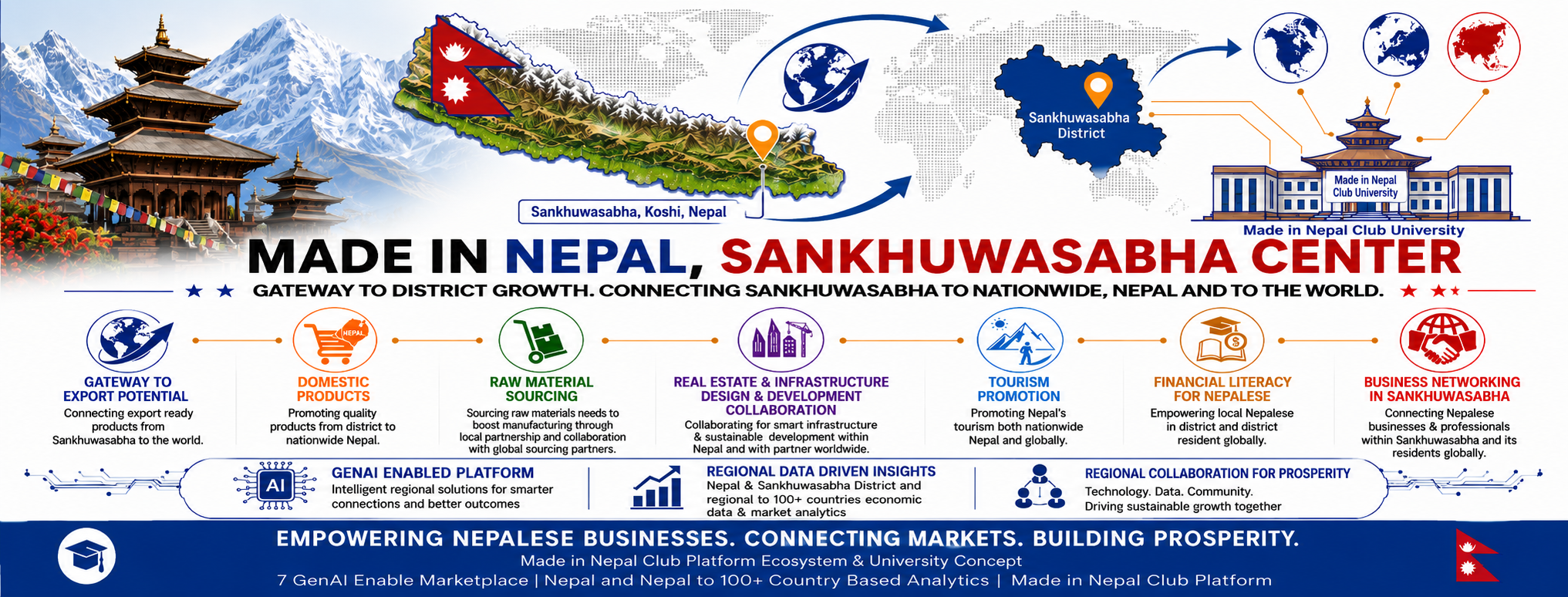
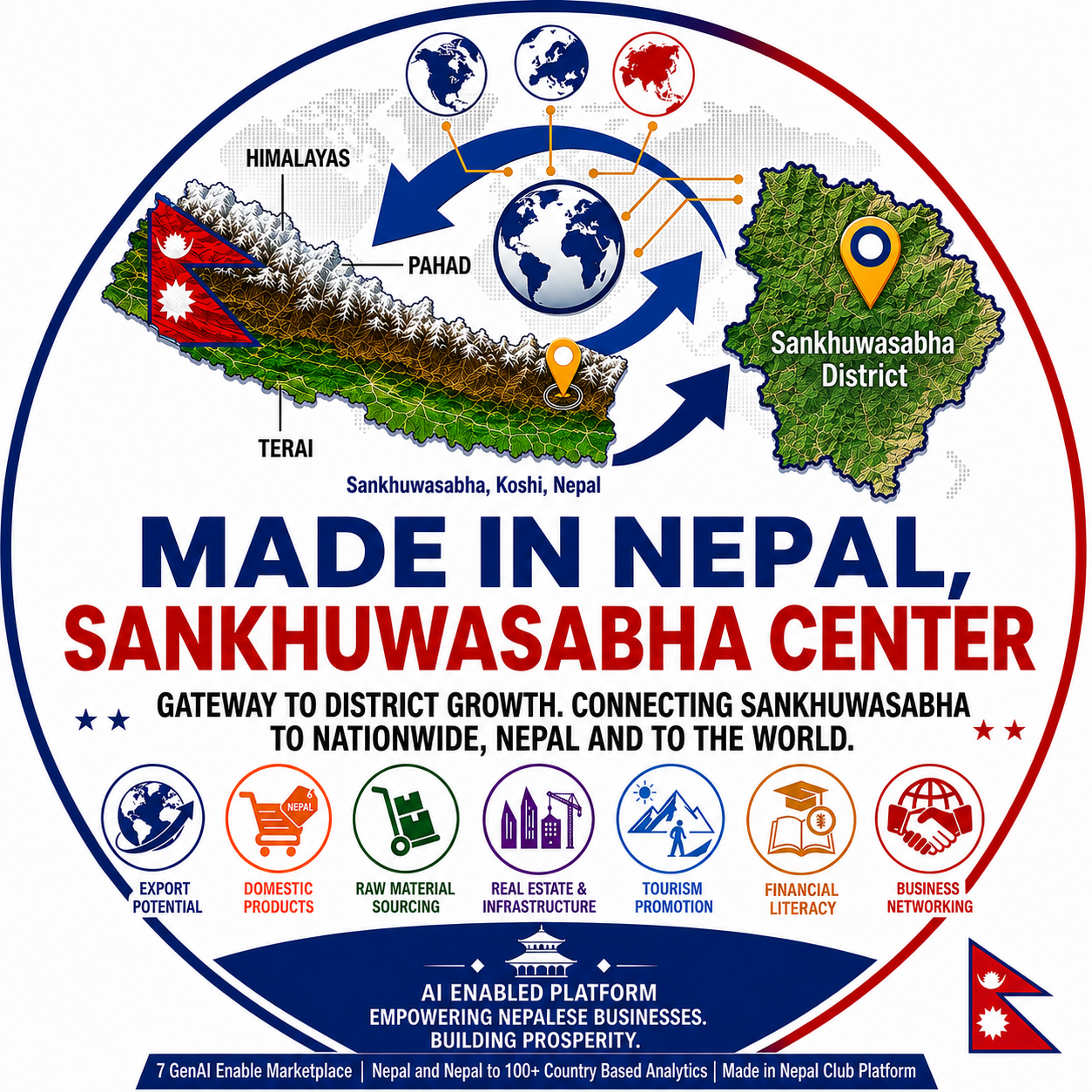
Gateway to Growth.
Connecting Sankhuwasabha to Nepal and the World.
VisitSankhuwasabha.com |
International + Nepal Business Strategy Brief
Sankhuwasabha Economic Gateway
From Cardamom, Arun Hydropower &
Makalu Tourism to Nationwide Scale
and Global Connectivity.
Strategic Research Brief
September 2026
Sankhuwasabha District,
Koshi Province, Nepal
Gateway to Export Potential •
Domestic Product Promotion •
Raw Material Sourcing •
Real Estate & Infrastructure
Design & Development Collaboration •
Tourism Promotion •
Financial Literacy for Nepalese •
Business Networking in Sankhuwasabha,
Nepal and to the World
One District. Three Markets.
A Strategic Himalayan–Arun Gateway.
Sankhuwasabha had
158,041 residents
in Nepal's 2021 census and
10 local governments.
Government sources place
the district area at approximately
3,480 km²,
with Khandbari
as the administrative center.
The 2018 Economic Census recorded
6,037 establishments
engaging 18,913 people
.
The district combines
large-cardamom and mountain agriculture,
the Arun hydropower corridor,
Tumlingtar aviation,
Makalu-Barun tourism
and strategic orientation
toward Kimathanka
on the China border.
Economic architecture:
SANKHUWASABHA DISTRICT →
NATIONWIDE NEPAL →
GLOBAL BUYERS, VISITORS,
INVESTORS, DIASPORA & TECHNOLOGY.
158,041Population · 2021
6,037Economic establishments · 2018
18,913Persons engaged · 2018
7,904Residents abroad · 2021
Seven Integrated Global Platforms
Benefit Sankhuwasabha businesses locally,
Nepal nationally and markets globally
Every feasibility study should test
district commercial impact,
Nepal-wide scalability
and global buyer,
visitor, investor,
technology and diaspora relevance.
1. Sankhuwasabha Businesses
2. Nationwide Nepal
3. Global Buyers /
Visitors / Investors / Diaspora
1
Gateway to Export Potential
Prioritize products where Sankhuwasabha
has measurable scale
or authentic differentiation.
Current Koshi Province data record
approximately
981.96 MT of large cardamom
,
42,005 MT of potato
and
2,204 MT of mandarin
.
The PMAMP Sankhuwasabha cardamom zone
separately reports
716.6 MT in FY 2081/82.
Commercialization should focus on
aggregation,
improved drying,
grading,
packaging,
traceability,
phytosanitary/certification readiness,
HS-code analysis
and buyer validation.
District:
farmers, cooperatives, processors.
Nepal:
wholesalers, exporters,
hospitality and retailers.
Global:
spice importers,
specialty buyers
and diaspora markets.
Market Research and Feasibility Study On:
Gateway to Export Potential
View Market Research
→
2
Domestic Product Promotion
Build a recognizable
Made in Sankhuwasabha
identity around Arun–Makalu origin,
large cardamom,
mandarin,
mountain agriculture,
local foods
and indigenous/cultural authenticity.
Use verified producer directories,
professional packaging,
QR origin stories,
Khandbari/Chainpur showcases,
Koshi trade events,
hospitality channels
and Nepal-wide e-commerce
before larger international promotion.
District:
producers and local markets.
Nepal:
Dharan, Itahari,
Biratnagar, Kathmandu
and national e-commerce.
Global:
diaspora,
specialty retail
and origin-focused buyers.
Prioritize efficient cardamom dryers,
disease-resistant planting material,
irrigation,
citrus post-harvest systems,
cold storage,
food/herb processing,
packaging,
solar systems,
digital-commerce tools
and hydropower/construction-related equipment.
Use a sourcing hierarchy of
Nepal first →
regional where efficient →
global where technology
or lifecycle economics justify it.
Every import study should include
freight, installation,
training, maintenance,
energy use
and spare-parts availability.
District:
higher productivity,
quality and lower loss.
Nepal:
suppliers, laboratories
and technical institutions.
Global:
OEM, certification
and technology partners.
Market Research and Feasibility Study On:
Raw Material &
Technology Sourcing
View Market Research
→
4
Real Estate & Infrastructure
Design & Development Collaboration
Focus on infrastructure
tied to real economic throughput:
collection/cold-chain hubs,
warehouses,
hydropower-support services,
worker housing,
hospitality,
road/logistics nodes,
water systems
and resilient urban infrastructure.
Investment Board Nepal lists
the
900 MW Arun-3
project at
Nrs 144 billion
(≈ USD 952.5 million)
and the
669 MW Lower Arun
at
Nrs 92.68 billion
(≈ USD 613.0 million)
using the September 7, 2026
reference exchange rate.
These projects create opportunities
for local suppliers,
skills, accommodation
and services,
but every private project
still needs independent feasibility.
District:
contractors, landowners,
MSMEs, workers
and municipalities.
Nepal:
developers, engineers,
banks and operators.
Global:
technical partners,
equipment suppliers
and screened investors.
Market Research and Feasibility Study On:
Real Estate & Infrastructure
Design & Development Collaboration
View Market Research
→
5
Tourism Promotion —
Visit Sankhuwasabha
Position Sankhuwasabha
as a high-value Himalayan nature,
trekking, biodiversity,
pilgrimage
and cultural destination.
Nepal Tourism Board identifies
Makalu-Barun National Park
,
Mt. Makalu—the world's
fifth-highest mountain—
and the Arun River
as core attractions,
with Tumlingtar
as the air gateway.
Government district material
also identifies
Sabha Pokhari,
Matsya Pokhari,
Manakamana,
Siddhakali
and Arun Valley
among major tourism resources.
The opportunity is to package
Tumlingtar–Khandbari–
Makalu/Sabha Pokhari circuits
into bookable
multi-day experiences.
District:
hotels, homestays,
guides, transport,
food and retail.
Nepal:
trekking agencies,
domestic tourism
and eastern circuits.
Global:
trekkers, mountaineers,
nature travelers,
pilgrims
and diaspora visitors.
Market Research and Feasibility Study On:
Tourism Promotion —
Visit Sankhuwasabha
View Market Research
→
6
Financial Literacy for Nepalese
Serve farmers,
cardamom traders,
tourism SMEs,
hydropower-linked businesses,
migrant households
and returnees
with budgeting,
bookkeeping,
productive credit,
insurance,
digital payments,
taxation awareness,
remittance planning,
foreign-exchange literacy,
trade finance
and responsible-investing education.
With
7,904 residents
recorded abroad
,
Sankhuwasabha has
a meaningful external capital,
skills and market network
that can be connected
to transparent local enterprise.
District:
resilient households
and enterprises.
Nepal:
formal finance,
banking
and entrepreneurship.
Global:
remittance,
diaspora capital
and returnee-business links.
Market Research and Feasibility Study On:
Financial Literacy for Nepalese
View Market Research
→
7
Business Networking in Sankhuwasabha,
Nepal and to the World
Use the district's
6,037 recorded economic establishments
as the starting base
for a verified B2B directory.
Connect farmers,
cardamom traders,
processors,
tourism businesses,
contractors,
transport/logistics firms
and professionals
to Nepal-wide buyers,
exporters,
banks,
hydropower supply chains
and institutions.
Then extend the network globally
to Sankhuwasabha-origin diaspora,
importers, investors,
tourism operators,
technical experts
and technology providers.
District:
trusted business discovery
and referrals.
Nepal:
buyers, finance,
hydropower procurement
and institutions.
Global:
diaspora, importers,
investors, mentors
and technology partners.
Market Research and Feasibility Study On:
Business Networking in Sankhuwasabha,
Nepal and to the World
View Market Research
→
High-value agriculture:
current Koshi Province data show
981.96 MT of large cardamom,
42,005 MT of potato
and 2,204 MT of mandarin
in Sankhuwasabha.
The business challenge
is to move from farm output
toward better drying,
post-harvest management,
quality, branding,
logistics
and direct buyer relationships.
Hydropower:
Arun-3 and Lower Arun
represent a major infrastructure
and procurement ecosystem.
Local opportunity should focus
on qualified services,
accommodation,
logistics,
workforce skills
and supplier development,
without assuming nearby property
or ancillary investments
are automatically viable.
Connectivity:
the Department of Roads identifies
the 162-km
Khandbari–Kimathanka road
as part of the North–South
Koshi Road Project.
The difficult
Chhyamtang–Ghonghappa
track section was completed in 2026,
connecting the track
toward Kimathanka,
but road upgrading continues.
Any China-facing freight model
must verify road condition,
customs/border operating status
and commercial rules
before investment.
Tourism + aviation:
CAAN lists Tumlingtar
as an operating domestic airport,
while NTB describes it
as the gateway to Makalu-Barun.
Better integration
of flights, road transfers,
trekking permits,
guides, accommodation
and local-product retail
can raise tourism value
retained inside the district.
Diaspora:
7,904 residents abroad
can become buyers,
mentors, investors,
tourism ambassadors
and technology scouts
when opportunities
are verified
and professionally screened.
International + Nepal Business Strategy
VisitSankhuwasabha.com
should operate as Sankhuwasabha's
integrated economic gateway
rather than as a tourism-only site.
The seven platforms should connect
production,
local commerce,
hydropower-linked demand,
Nepal-wide distribution,
infrastructure,
destination development,
financial capability
and global networks
under one market-development architecture.
LOCAL VALUE CREATION +
NATIONWIDE DISTRIBUTION +
GLOBAL MARKET ACCESS +
CARDAMOM + HYDROPOWER +
MAKALU TOURISM +
KOSHI CORRIDOR +
DIASPORA CAPITAL +
B2B NETWORKS
Initial Execution Priorities
Build the verified Sankhuwasabha
producer/business directory;
map cardamom drying
and mandarin post-harvest gaps;
create a local-supplier registry
for hydropower and infrastructure procurement;
package Tumlingtar–Khandbari–
Makalu/Sabha Pokhari tourism circuits;
assess Kimathanka/Koshi Corridor
logistics readiness;
and activate the diaspora
for buyers, mentorship
and screened investment introductions.
Turning Sankhuwasabha's Himalayan Assets
Into Measurable Economic Opportunity
VisitSankhuwasabha.com /
Made in Nepal, Sankhuwasabha Center
can connect farmers,
processors,
tourism communities,
hydropower-linked enterprises,
youth and entrepreneurs
with Nepal's domestic economy
and with global buyers,
visitors, investors,
diaspora
and technology partners.
Currency Standard:
All financial figures
on this platform
are displayed in
Nrs and USD.
Nepal Rastra Bank's
7 September 2026
published rate was
USD 1 =
Nrs 150.88 buying /
Nrs 151.48 selling.
For indicative conversions,
this research uses
the midpoint of approximately
Nrs 151.18 = USD 1
.
Therefore
Nrs 144 billion ≈
USD 952.5 million,
and
Nrs 92.68 billion ≈
USD 613.0 million.
Actual banking
and transaction rates may differ.
Research & Information Disclaimer:
This page is intended
for general district economic-development,
business, trade, tourism,
infrastructure
and financial-education information.
It does not constitute
legal, tax, engineering,
customs, regulated financial
or investment advice.
Product markets,
technology purchases,
infrastructure projects,
hydropower-linked opportunities,
road/border assumptions,
tourism concepts
and investments
should undergo current technical,
regulatory, market
and financial feasibility review.
Research Published by
Jay Sarraf, USA, Currently in Kathmandu,Nepal
,
Supported by
The Raj Sarraf, USA